When “Clear” Water Isn’t the Full Story
If you live in Naugatuck, your water may look perfectly fine at first glance. It runs clear, doesn’t always smell, and seems safe enough for everyday use.
But recent water supply tests we conducted across the town tell a more nuanced story.
Two nearby homes—drawing from the same regional groundwater—showed very different water profiles. One sample met all safety standards. The other failed potability guidelines due to elevated contaminants, even after treatment.
That’s the reality of private well water: conditions can change dramatically from one street to the next.
Understanding Local Water: What Our Tests Revealed
Our analysis in Naugatuck focused on two residential wells, and the results highlight five key water quality characteristics every homeowner should understand.
Chloride: When Salt Becomes a Problem
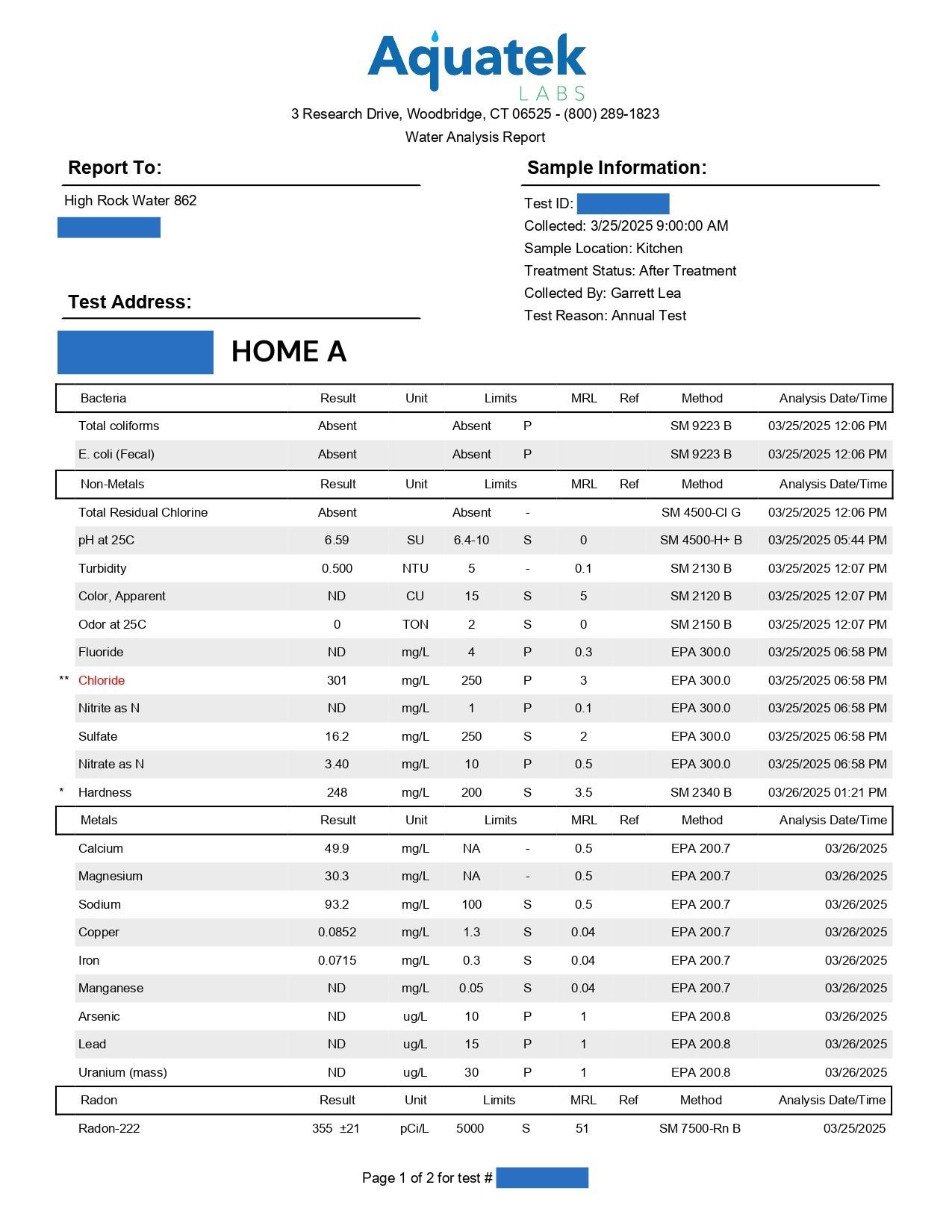
One of the most significant findings came from Home A, where the chloride level measured 301 mg/L, exceeding the recommended limit of 250 mg/L.
Chloride itself isn’t always dangerous at moderate levels, but elevated concentrations often indicate contamination sources such as road salt runoff or brine discharge from a water softener.
The location of that discharge matters. If the softener’s backwash or brine discharge is released too close to the well, chloride can migrate into the groundwater and contribute to higher test results over time.
In this case, the sample was flagged as not safe for drinking, even though it had already been treated. That distinction matters. If chloride levels are high, treatment systems may need adjustment—or the contamination source may still be active.
If your home is near treated roads or uses a water softener, this is something worth testing directly.
Hardness: A Hidden Cost to Your Home
Water hardness varied significantly between locations.
- Home A: 248 mg/L (Hard water)
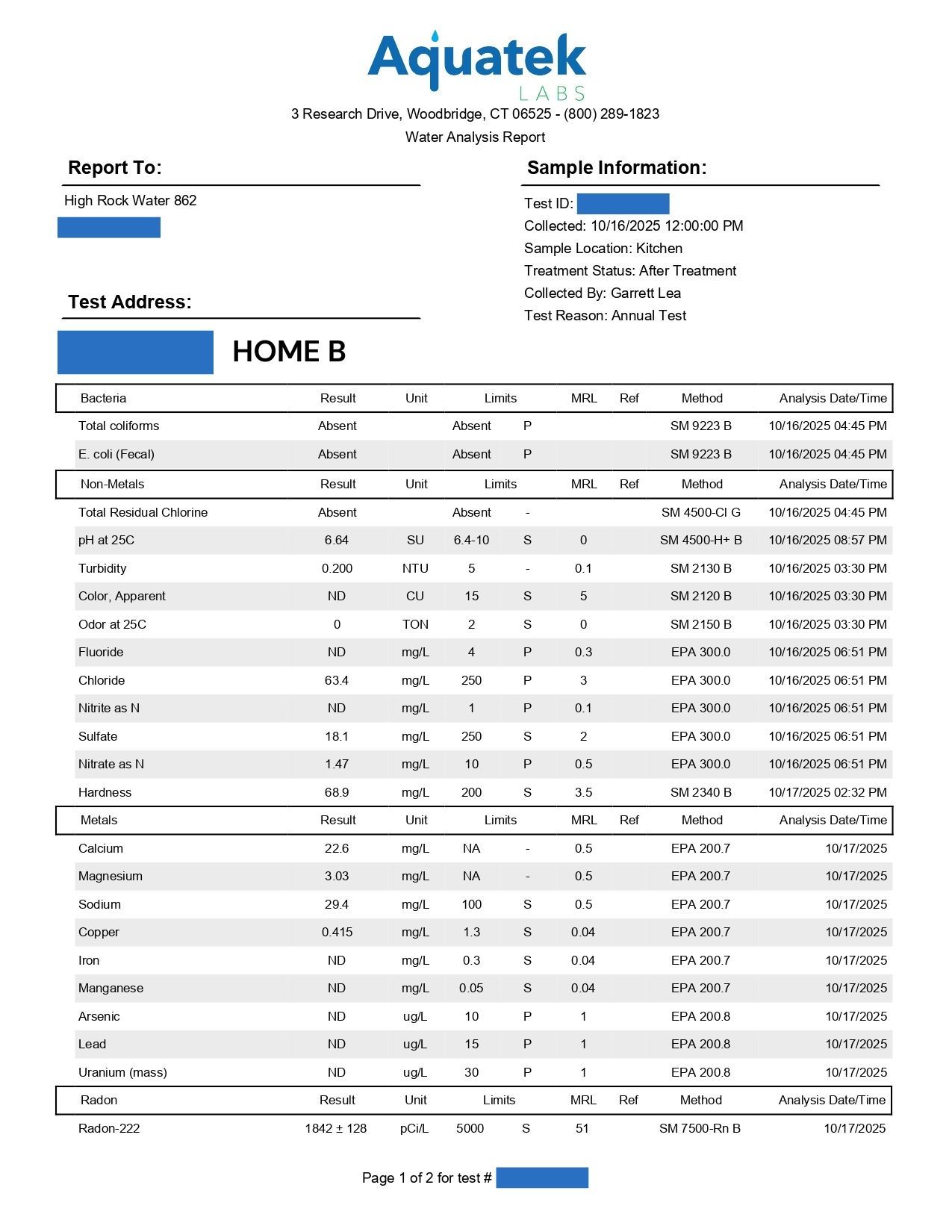
- Home B: 68.9 mg/L (Moderately soft)
Hard water, caused by calcium and magnesium, is extremely common in Connecticut groundwater. While it’s not considered a direct health risk, it has clear consequences inside the home.
Scale buildup reduces the efficiency of water heaters, clogs pipes over time, and leaves residue on fixtures and glassware.
Research shows that hardness comes from groundwater interacting with mineral-rich rock formations, particularly limestone and similar deposits.
If your appliances seem to wear out faster or your faucets develop white buildup, hardness is likely a factor—even if your water is technically “safe.”
Radon: The Invisible Variable
Both wells tested positive for Radon-222, a naturally occurring radioactive gas commonly found in groundwater across Connecticut.
- Home A: 355 pCi/L
- Home B: 1,842 pCi/L
Both values are below Connecticut’s advisory threshold of 5,000 pCi/L, meaning they are not considered immediately unsafe. However, the variation between two nearby homes is significant.
According to the United States Environmental Protection Agency, radon exposure is primarily a concern when it enters indoor air. Water can contribute to that exposure during daily activities like showering.
Even when levels are below regulatory concern, testing is important—because radon is entirely dependent on local geology, not distance between homes.
Sodium: A Quiet Indicator of Larger Issues
The sodium level at Home A reached 93.2 mg/L, approaching the recommended limit of 100 mg/L.
This often correlates with elevated chloride levels and may point to related underlying causes, such as road salt contamination or the normal ion exchange process in a water softener.
In water softeners, sodium is used to replace calcium and magnesium—the minerals that cause hardness. As part of this treatment process, a small amount of sodium naturally enters the water. It’s typically not enough to affect taste, but it is enough to appear on a lab report.
While sodium in drinking water is usually not a concern for most people, it can be important for those on sodium-restricted diets and may also serve as an indicator of broader water quality patterns.
When sodium and chloride rise together, it’s rarely a coincidence—it’s a pattern.
pH Levels: Acceptable, but Worth Watching
Both samples showed slightly acidic to neutral pH:
- Home A: 6.59
- Home B: 6.64
While the state may only flag pH below 6.4, anything below 7.0 is considered acidic and can make water corrosive.
At this level, corrective measures are often recommended to bring the water back to a neutral range above 7.0, especially in homes with copper plumbing. Early signs of corrosive water can include blue-green staining in sinks or fixtures.
Even though these samples were not formally flagged, the water should still be considered corrosive and worth addressing to prevent long-term damage to pipes.
Our Professional Recommendations to Each Home
When we deliver a water analysis report, our job isn't just to provide data—it's to provide a path to clean, safe water. Here is how we addressed the specific needs of these two Naugatuck households.
Home A: Corrective Action and Safety First
Because the sample from Home A failed to meet essential safety standards, our team took an immediate, proactive approach:
- Safety Status: We officially flagged the water as not safe for drinking because it failed to meet established EPA and/or CT potability standards.
- Mandatory Corrective Measures: We recommended immediate corrective measures to address the elevated chloride and hardness levels.
- System Re-Examination: Because the sample was taken "After Treatment" and still failed, we recommended a professional re-examination of the existing filtration system to identify why it was not successfully removing these contaminants.
Secondary Limit Monitoring: We noted that the water exceeded the Secondary Limit for hardness (248 mg/L), which, while not a direct health threat, requires mechanical intervention to protect the home’s plumbing.
Home B: Continued Vigilance and Baseline Testing
For Home B, the results were positive, but the service provided was no less critical:
- Certification of Safety: We confirmed that this water meets all established EPA and CT potability standards and is safe for drinking.
- Annual Baseline Maintenance: This test was conducted as an "Annual Test". We recommend that even "safe" wells be tested yearly to ensure that shifting groundwater conditions haven't introduced new risks.
- Radon Monitoring: While the radon level of 1,842 pCi/L was well below the Connecticut advisory limit of 5,000 pCi/L, we provided this data so the homeowner has a baseline to monitor for any future increases.
Our Commitment to Naugatuck
At High Rock Water, we don’t just "test and leave." For homes like Home A, we work with the residents to troubleshoot their treatment systems until the water is safe. For homes like Home B, we provide the peace of mind that comes with knowing your family is protected.
What This Means for Your Home
The most important takeaway from our testing in Naugatuck is not just what was found, but how much conditions varied.
Two homes, same town:
- One met all safety standards
- One failed due to chloride contamination
That variability is exactly why private well testing is critical.
You can’t assume your water is safe based on your neighbor’s results—or even your own past tests.
Common Questions About Well Water in Naugatuck
Is hard water dangerous to drink?
No, hard water is primarily an aesthetic and mechanical issue. It affects plumbing and appliances more than health.
Should I worry about radon in my water?
Only testing can determine that. While many wells show low levels, radon varies significantly depending on geology.
What causes high chloride in well water?
Most commonly, road salt runoff or contamination from water softener systems.
If my water looks clear, is it safe?
Not necessarily. Many contaminants—including chloride and radon—are invisible and odorless.
From Uncertainty to Control
Water quality issues rarely announce themselves all at once. They show up gradually—through stains, buildup, subtle taste changes, or test results that don’t quite meet standards.
The difference between a minor inconvenience and a real problem is often timing. Catching issues early allows for simple, targeted solutions.
Waiting too long can lead to system damage, costly repairs, or unsafe conditions.
Get a Clear Answer About Your Water
If you rely on a private well in Naugatuck, the only way to truly understand your water is through professional testing. Being proactive with your water supply is also being proactive with your health!
Our team provides detailed well water analysis based on local conditions, identifying exactly what’s in your water and what—if anything—needs to be addressed.
Schedule your professional water test today or call us immediately and get a clear, accurate picture of your home’s water quality. Let's get your water clean again!
CT'S Best Well Water Service Professionals
OVER 50 YEARS OF COMBINED EXPERIENCE
Our plumbers have a profound experience on working residential property.
CERTIFIED & LICENSED PLUMBERS
Our plumbers have the latest certifications and trainings to ensure they are educated on new technology.
FREE QUOTES ON ALL SERVICES
At High Rock Water & Mechanical Service, we provide free quotes for any of our customers.
WELL KNOWN IN THE CONNECTICUT AREA
We have been servicing our customers in and around the western and central CT area for over a decade.
HIGHLY RATED ON GOOGLE
Our reviews show how dedicated we are to helping our customers.
100% CLIENT SATISFACTION
Our goal is to have all of our customers to be happy customers and to think of High Rock Water & Mechanical Service whenever they need us.