When Clear Water Still Hides Problems
If you live in Bethany, your well water may seem perfectly normal. It looks clean, tastes fine, and nothing immediately suggests a problem.
But our recent testing across four different homes in town tells a very different story. On the surface, each of these homes looked the same.
However, within the same community, groundwater conditions varied dramatically—from balanced, healthy water to extremely high radon levels and corrosive conditions that can quietly damage plumbing for years.
Normal kitchens. Fill glasses of water. Nothing that would make a homeowner stop and question what was coming out of the tap.
But once the samples were tested, the story underneath told something entirely different: one home with radon levels far above advisory limits, another with silent corrosion already beginning inside the pipes, and another balancing treatment systems that were solving one issue while quietly creating another.
What these CT well water testing results from High Rock Water Mechanical Services & show is simple: in private well systems, your neighbor’s water tells you almost nothing about your own.
From the outside, you’d never know.
Understanding Local Water: What Our Tests Revealed
Our analysis in Bethany focused on four separate residential wells. Most were tested after treatment systems were already in place, yet the differences remained significant.
Several major patterns stood out:
- Major radon variation from one home to another
- Acidic water creating corrosion risks
- Water softeners removing hardness while increasing sodium
- Hidden chloride and mineral loads affecting long-term plumbing health
Each of these matters has a different reason, as you can see below.
Radon: The Geological Roulette Problem
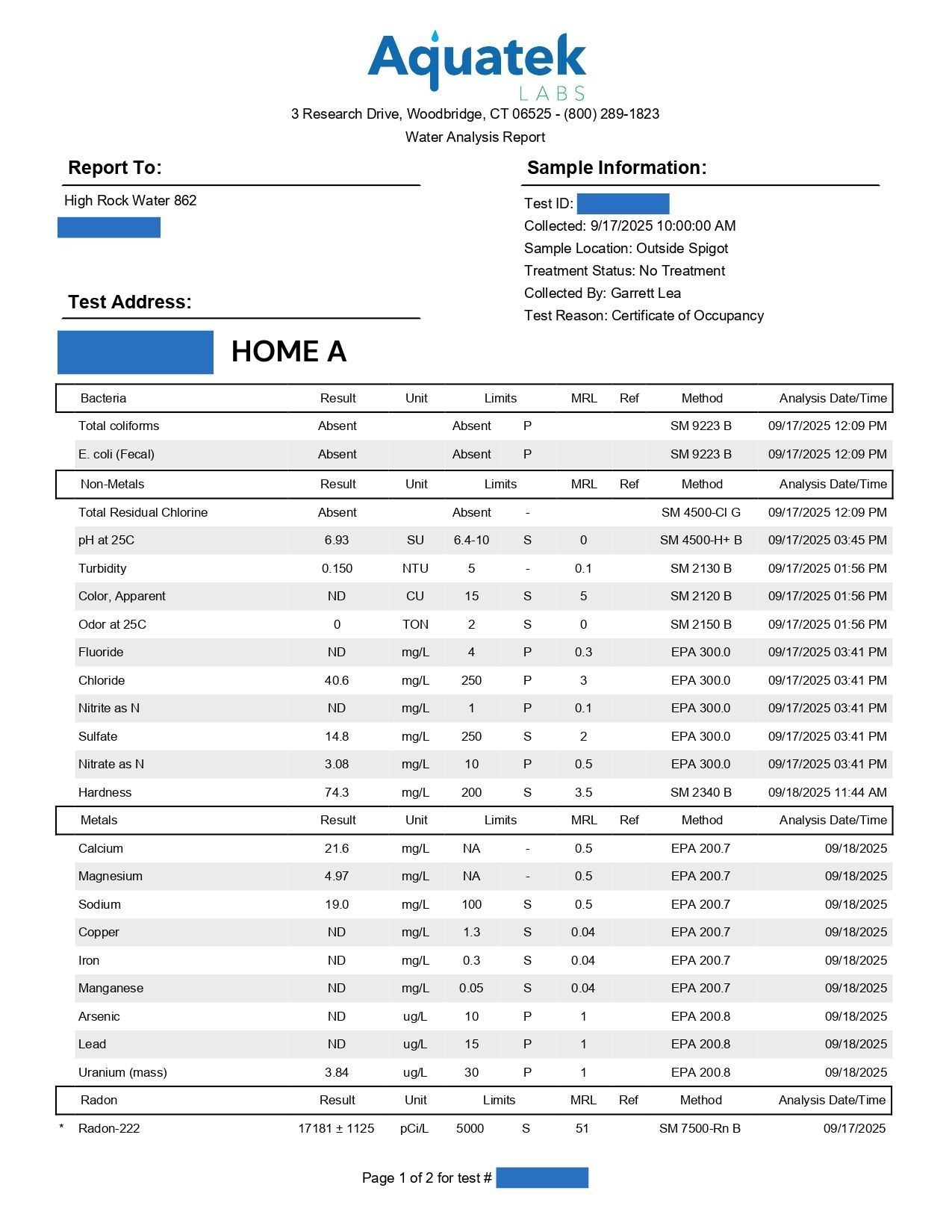
The most serious finding came from Home A, where Radon-222 measured 17,181 pCi/L.
That is more than three times Connecticut’s advisory level of 5,000 pCi/L. Meanwhile:
- Home B: 4,191 pCi/L
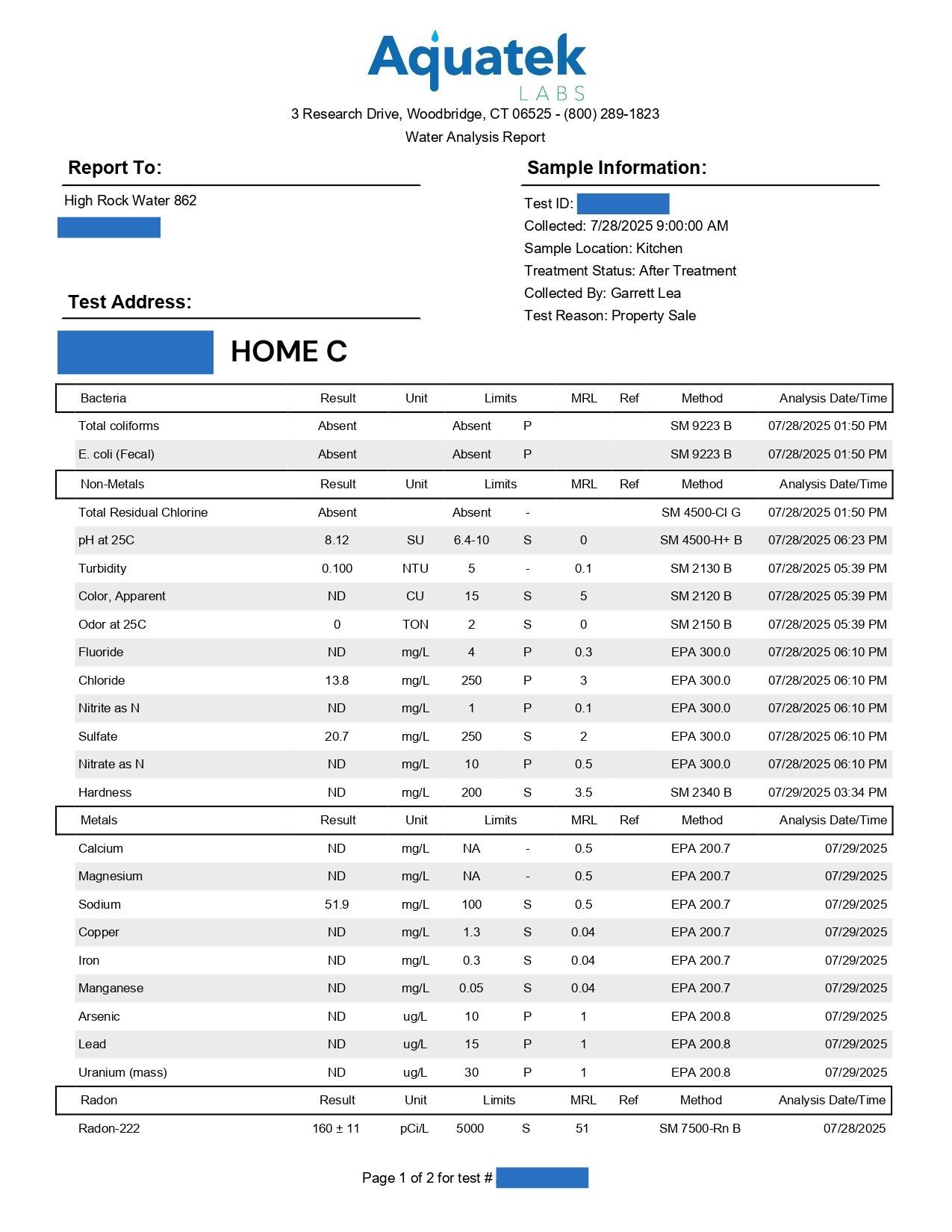
- Home C: 160 pCi/L
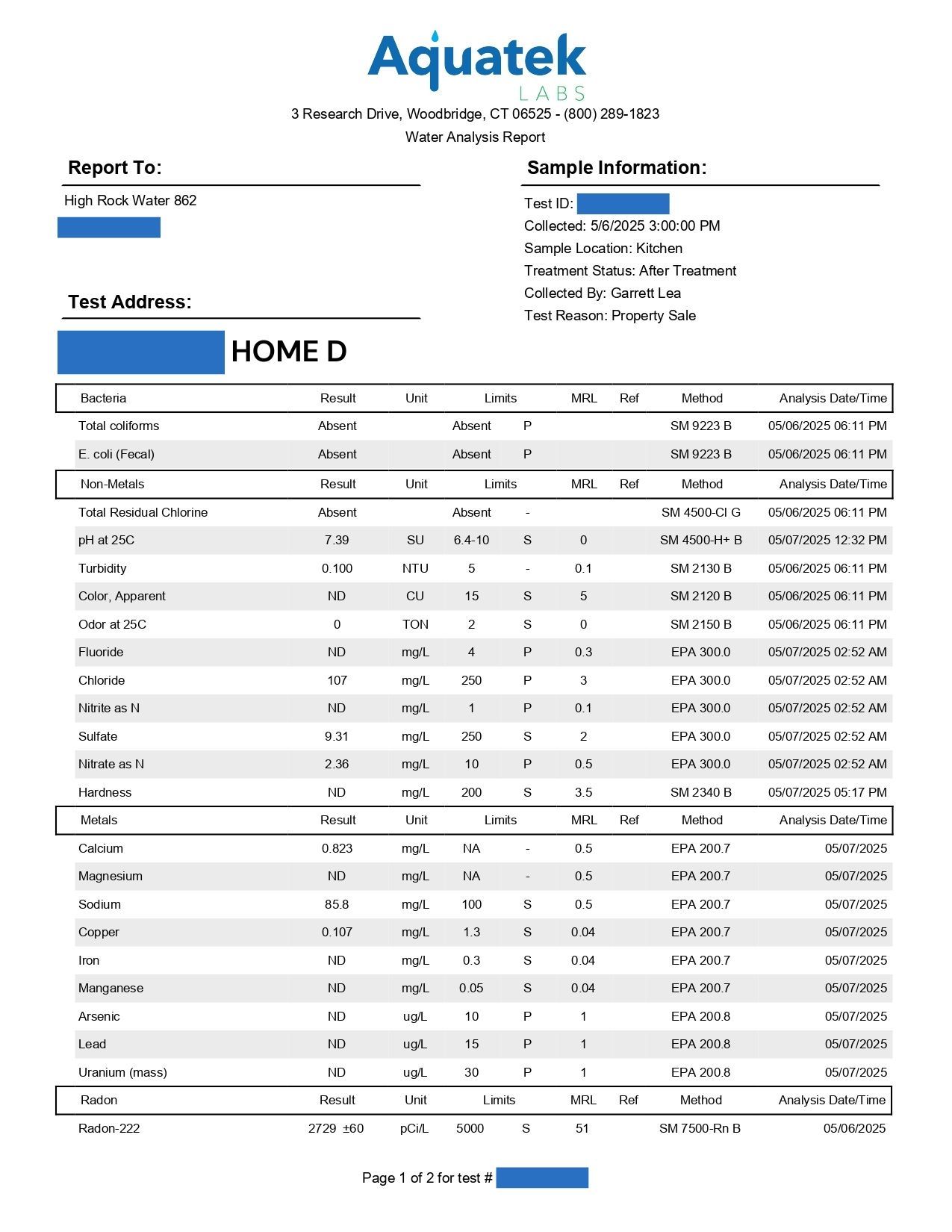
- Home D: 2,729 pCi/L
Same town. Massive difference.
This is one of the most important lessons for well owners: radon depends almost entirely on hyper-local geology. Two homes on the same road can have completely different radon exposure risks.
According to the United States Environmental Protection Agency, radon exposure is primarily dangerous when it enters indoor air during showering, laundry, and daily water use. Long-term exposure increases lung cancer risk.
Even when a water report says “safe,” high radon numbers should never be ignored. Home A would require professional correction, typically through a point-of-entry aeration system.
pH: The Quiet Cause of Pipe Damage
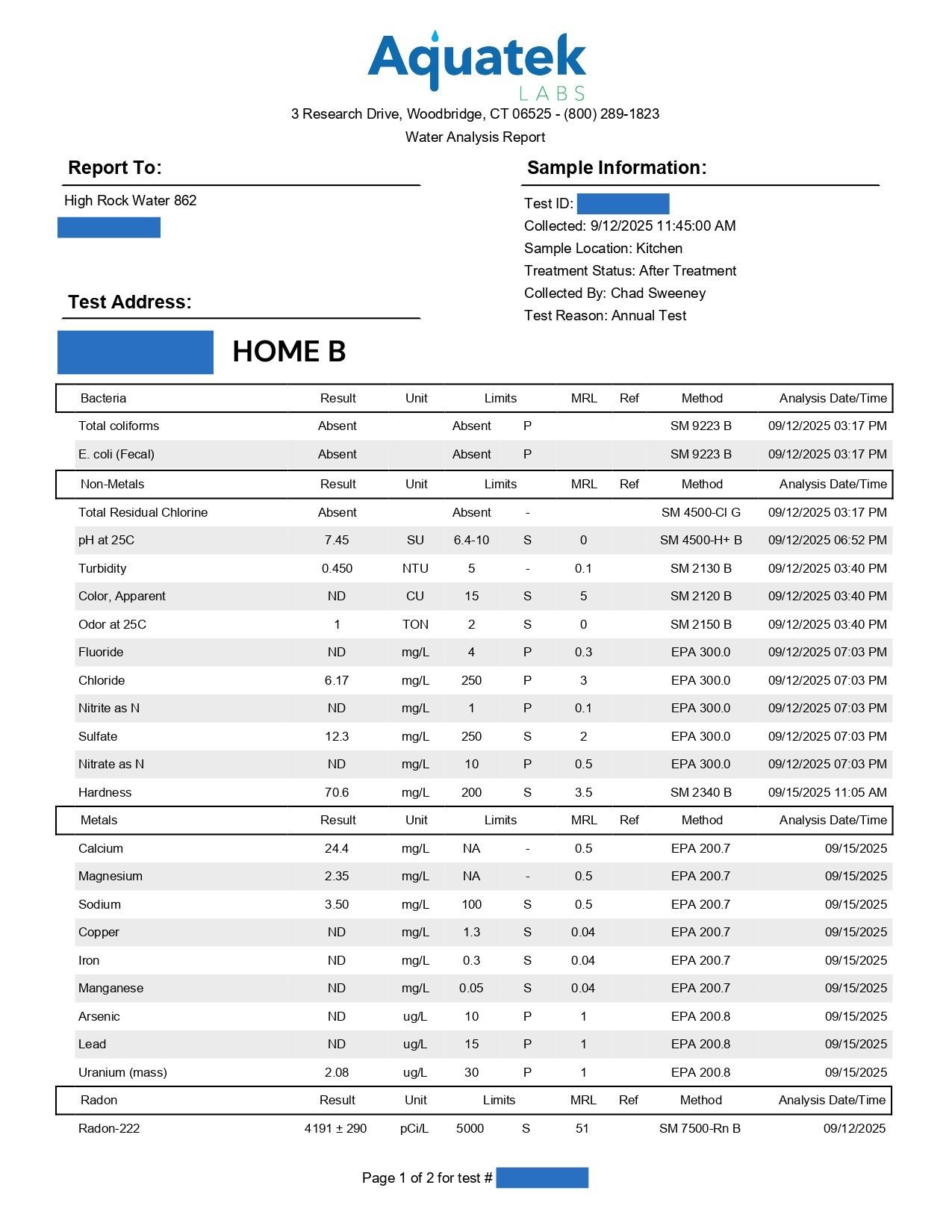
At Home A, pH measured 6.93.
Technically, Connecticut often flags pH concerns at or below 6.4—but from a plumbing perspective, anything below 7.0 is considered acidic and should be corrected.
Acidic water becomes corrosive over time. It slowly eats at copper plumbing, often causing:
- Blue-green staining in sinks
- Metallic taste in water
- Pinhole leaks in pipes
- Premature plumbing failure
This is one of the easiest problems to miss because the water may still look perfectly normal.
Professional neutralizing systems are designed to bring water back above 7.0 and protect the plumbing system long-term.
Hardness: When Soft Water Comes at a Cost
Water hardness across the homes varied significantly.
- Home A: 74.3 mg/L
- Home B: 70.6 mg/L
- Home C: Non-detect (fully softened)
- Home D: Non-detect (fully softened)
Homes C and D clearly have highly effective softener systems removing calcium and magnesium completely.
That protects appliances, prevents scale buildup, and improves overall plumbing performance.
But there’s an important trade-off, as you'll see in the next section.
Sodium: The Water Softener Trade-Off
As hardness disappears, sodium often rises.
That’s because ion exchange softeners remove calcium and magnesium by replacing them with sodium.
This is not contamination—it’s how the system works.
Our testing showed:
- Home A: 19.0 mg/L
- Home B: 3.50 mg/L
- Home C: 51.9 mg/L
- Home D: 85.8 mg/L
Home D had the highest sodium load, approaching the secondary recommended limit of 100 mg/L.
This doesn’t usually create taste issues, but it matters for homeowners on sodium-restricted diets, and it tells professionals that the softener is working heavily to correct source water conditions.
When sodium climbs, it often means the system is fighting significant hardness or mineral load upstream.
Chloride: The Sign That Something Else May Be Happening
At Home D, chloride measured 107 mg/L.
This is still within safe limits, but it warrants attention—especially when paired with elevated sodium intake. High chloride can be linked to:
- Road salt runoff
- Natural groundwater mineral content
- Brine movement depending on the softener discharge location and proximity to the well
This is why a well water filtration system placement matters. If discharge is too close to the well system, it can influence long-term water chemistry.
Professionals look at sodium and chloride together because they often tell the same story.
The Most Important Lesson: “Safe” Doesn’t Always Mean Safe
One of the most concerning findings came from Home A.
The lab summary stated the water was “safe for drinking,” yet the report clearly showed Radon-222 at 17,181 pCi/L, flagged above advisory levels.
This is where homeowners can get false peace of mind. A summary line should never replace a full professional interpretation of the data.
Real water analysis means looking past the label and understanding what each number actually means for your home, your plumbing, and your long-term safety.
This is the turning point in every water report we review.
Numbers alone don’t protect a home—understanding them does. And as we saw across these four Bethany properties, the differences aren’t small. They’re the kind that can quietly impact air quality, plumbing lifespan, and long-term health.
That’s where professional interpretation becomes just as important as the test itself.
Our Commitment to Bethany
At High Rock Water, we’ve worked extensively with private well systems throughout Bethany and the surrounding areas. We’ve seen firsthand how dramatically water conditions can change from one property to the next—even between homes on the same street.
It means we don’t rely on assumptions or generic solutions. We understand the geological patterns behind radon spikes, the long-term effects of acidic water on plumbing, and how treatment systems behave over time in this specific region.
Our role goes beyond testing.
We help homeowners interpret what their results actually mean, identify risks that may not be obvious on a lab summary, and recommend solutions that are designed for their exact water conditions—not someone else’s.
Because protecting your water means understanding it at a local level.
From Hidden Risk to Real Control
For most homeowners, there isn’t a single moment when water suddenly becomes a concern. There’s no alarm. No obvious failure.
Instead, it’s usually a series of small, easy-to-ignore signs—a faint metallic taste, a fixture that stains a little faster than it should, or a lab report that says “safe” without telling the full story.
And by the time those small signs connect, the issue has often been there for years. Most water quality issues don’t start with a major emergency.
They start quietly: a stain, a metallic taste, a pinhole leak, or a lab report that looks “mostly fine.”
The sooner those signs are understood, the easier the solution becomes. Waiting too long turns maintenance into major repairs.
Take Control of Your Water Supply
Your well water is one of the most important systems in your home—and one of the least visible.
It doesn’t come with alerts when something changes. It doesn’t warn you when radon levels rise, when pH turns corrosive, or when mineral balance begins to shift.
That’s why testing isn’t a one-time decision—it’s an ongoing way to protect your home and the people in it. Regular, professional water testing ensures that what you’re drinking, cooking with, and breathing in through daily use remains safe over time—not just on paper, but in reality.
Because when it comes to your water, certainty isn’t something you guess. It’s something you test.
Get a Clear Answer About Your Water
If your home relies on a private well in Bethany, the only way to truly know what’s in your water is professional testing.
Our team provides complete well water analysis based on real local conditions—identifying radon, pH imbalance, hardness, sodium, chloride, and the treatment systems needed to protect your home.
Schedule your professional well water test today and get real clarity about your water quality.
CT'S Best Well Water Service Professionals
OVER 50 YEARS OF COMBINED EXPERIENCE
Our plumbers have a profound experience on working residential property.
CERTIFIED & LICENSED PLUMBERS
Our plumbers have the latest certifications and trainings to ensure they are educated on new technology.
FREE QUOTES ON ALL SERVICES
At High Rock Water & Mechanical Service, we provide free quotes for any of our customers.
WELL KNOWN IN THE CONNECTICUT AREA
We have been servicing our customers in and around the western and central CT area for over a decade.
HIGHLY RATED ON GOOGLE
Our reviews show how dedicated we are to helping our customers.
100% CLIENT SATISFACTION
Our goal is to have all of our customers to be happy customers and to think of High Rock Water & Mechanical Service whenever they need us.