When Neighbors Share a Town but Not a Water Supply
If you live in Oxford, your well water might seem perfectly fine. It looks clear, tastes normal, and nothing about it would make you stop at the tap and wonder.
But our recent well water testing across five homes in town tells a very different story.
Within the same community, sometimes on the very same road, groundwater conditions varied dramatically. Some had active bacterial contamination that made their water unsafe to drink. One home showed radon levels more than three times Connecticut's advisory limit, while another just a few streets away registered levels nearly ten times lower.
Same town. Completely different water.
What these Oxford well water testing results show is something every private well owner needs to understand: your neighbor's water tells you almost nothing about your own.
Understanding Local Water: What Our Tests Revealed
Our analysis in Oxford covered five reports across five distinct residential wells. The tests included both routine annual check-ups and property sale inspections, giving us a broad picture of what Oxford groundwater actually looks like right now.
Several major patterns stood out immediately:
- A sharp divide between safe and contaminated homes, with no middle ground
- A bacterial hotspot concentrated
- Extreme radon variation between properties in the same town
- Chemical and mineral levels that were largely within safe limits across the board
Each of these findings has a different cause and a different solution.
The Bacterial Divide: Safe vs. Unsafe, Street by Street
The most immediate finding from our Oxford testing was how clearly homes split into two groups when it came to bacteria.
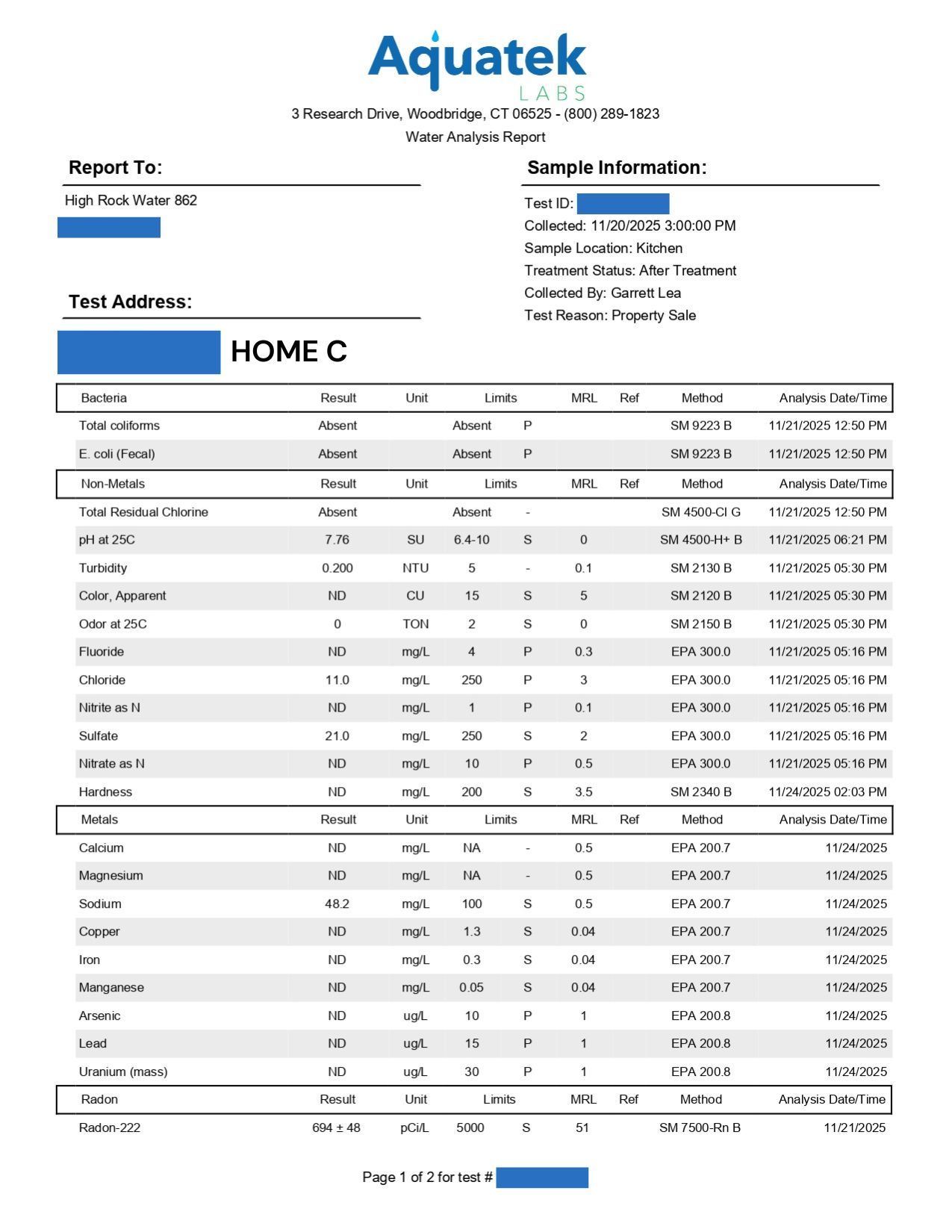
- Homes A and C both returned clean results. Total Coliforms and E. coli were absent. These homes are safe to drink from.
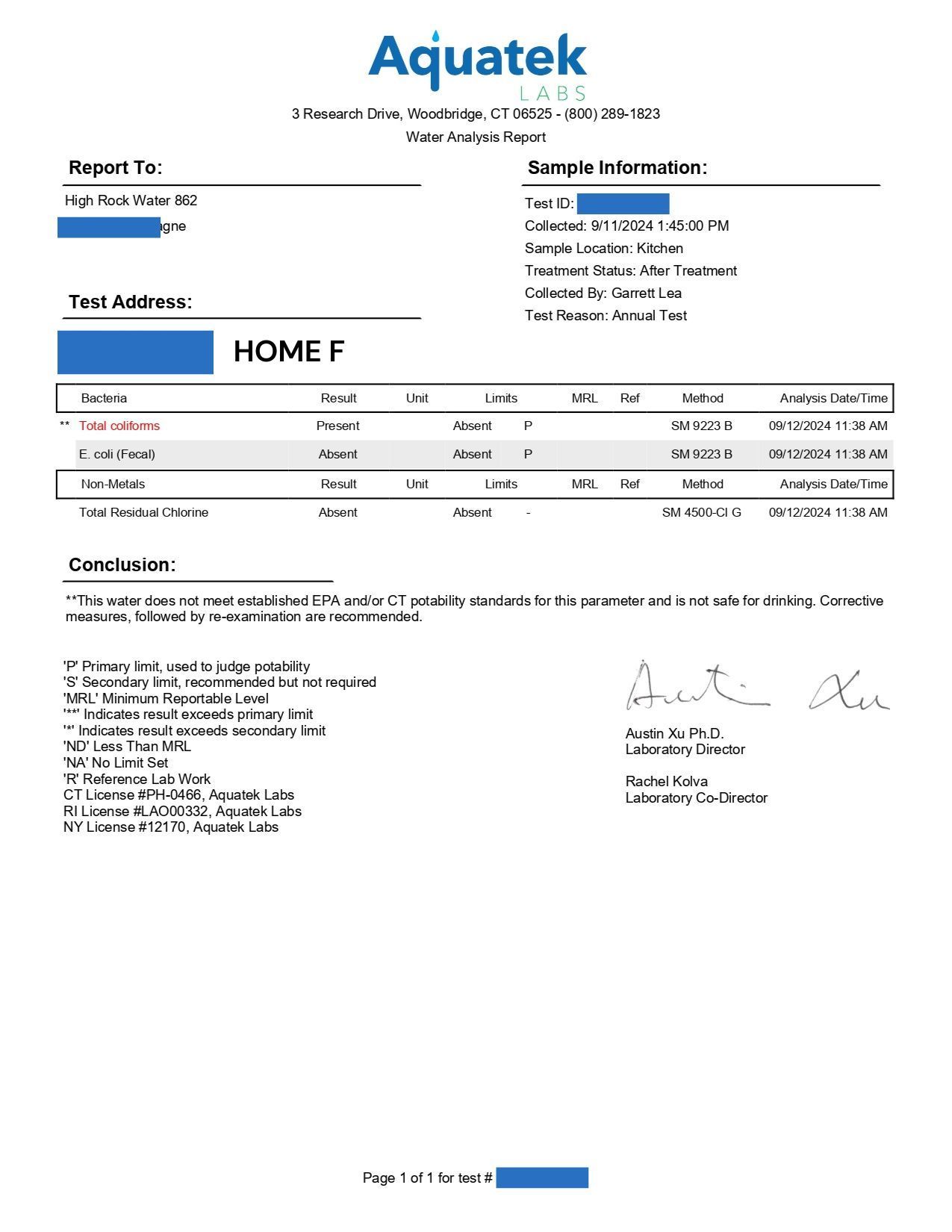
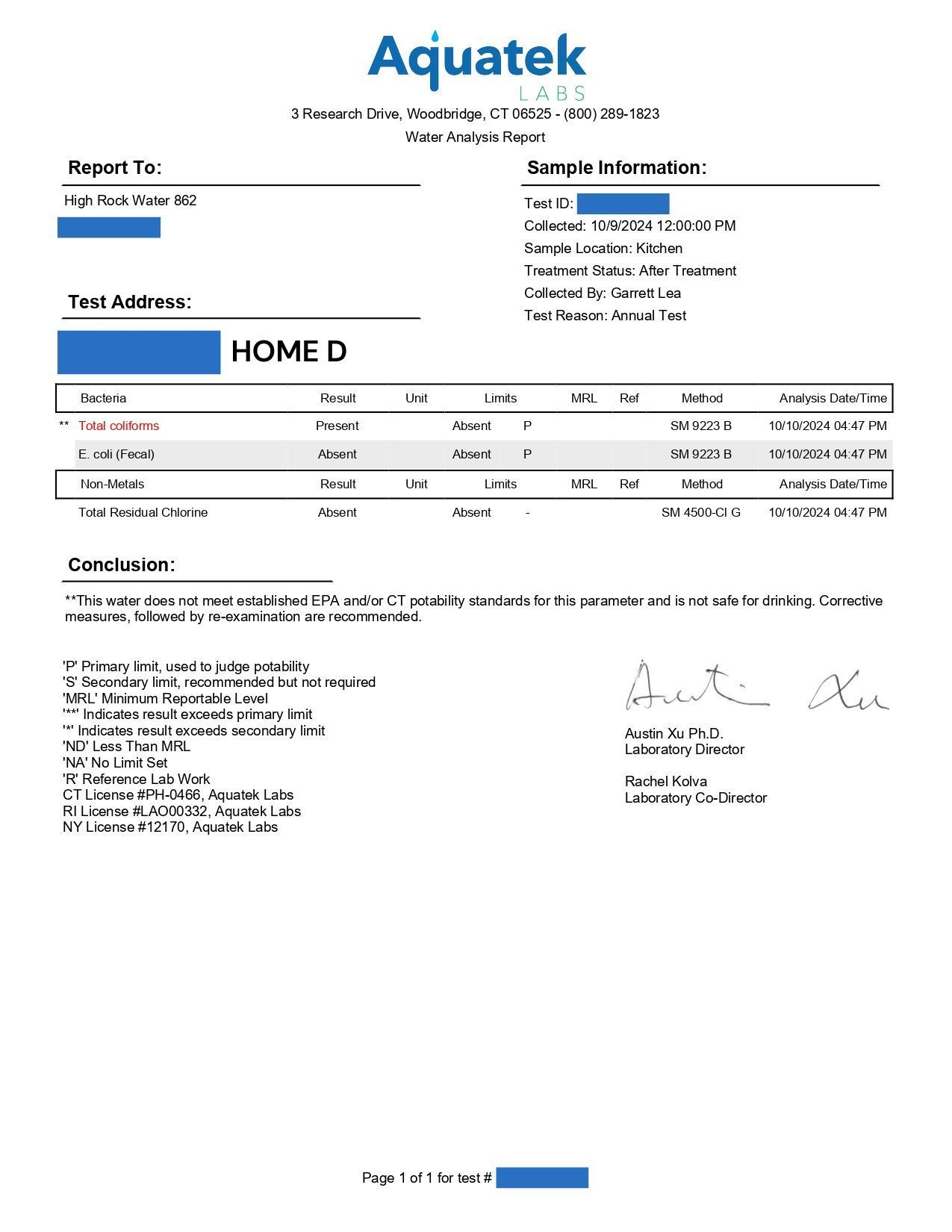
- Homes D, F, and G all failed potability standards. Every one of these properties tested positive for Total Coliforms, the standard indicator that something has gone wrong with the well's integrity or the surrounding groundwater.
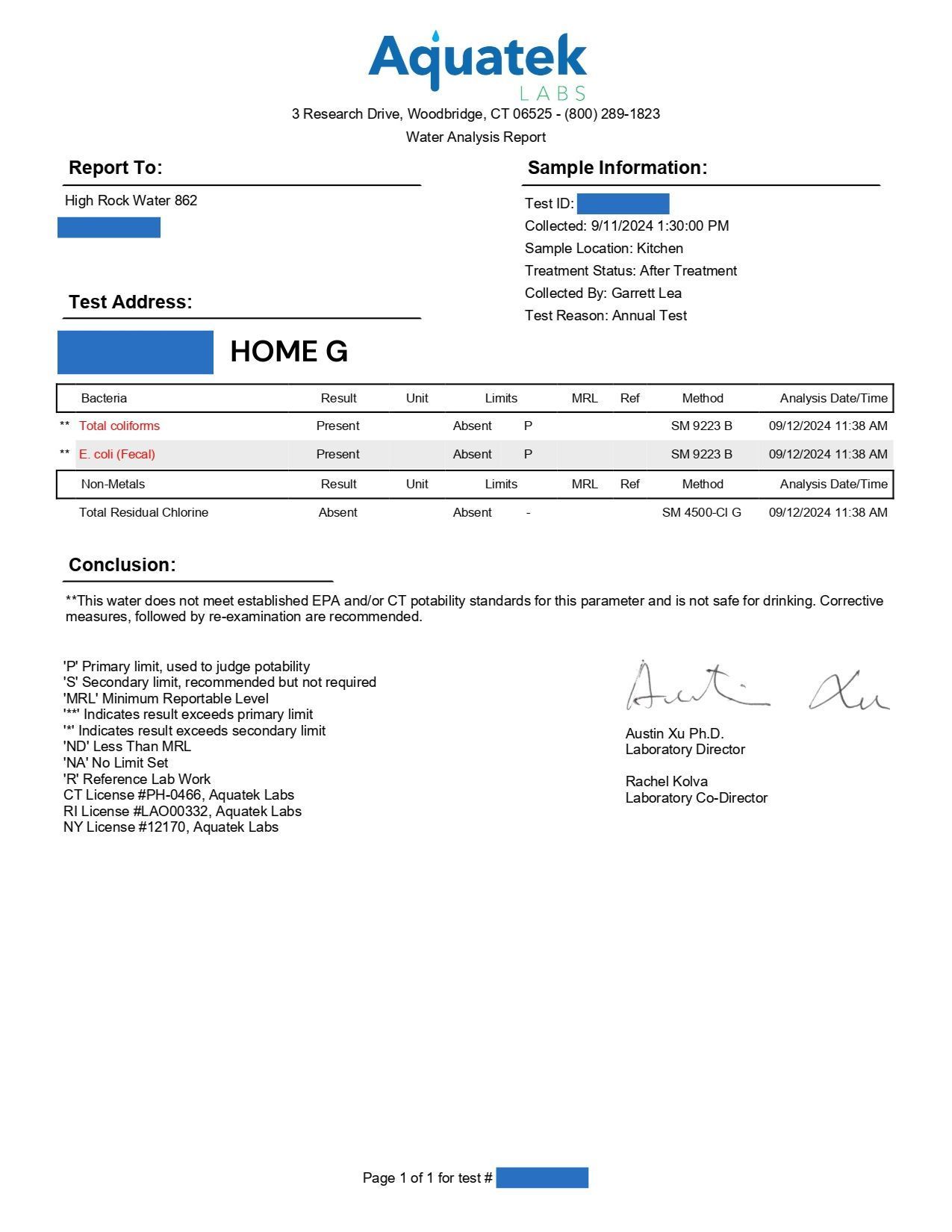
Home G had the most serious result of the group: both Total Coliforms and E. coli (fecal) were present, indicating a deeper level of contamination that demands immediate attention.
There was no gradual slide here. It was a clean split: some homes are safe, others are not.
For the three homes with contamination, corrective treatment and re-testing are not optional; they are necessary before the water is safe for any household use.
Fecal Bacteria E. coli: A Closer Look at the Hotspot
Of all the findings in this analysis, this one stands out as the most concerning.
E. coli is a direct indicator of fecal contamination entering the water supply. This is not a borderline result. It indicates a more severe or more direct contamination pathway than simple coliform presence alone.
Whether this is due to a compromised well casing, proximity to a septic system, surface water intrusion, or another cause entirely, it requires immediate professional evaluation.
Shock chlorination and re-testing are typically the first steps, but understanding the source of contamination is just as important as treating it.
Radon: The Geological Roulette Problem
For homes without bacterial contamination, radon becomes the next major concern, and Oxford follows the same unpredictable pattern we see throughout Connecticut.
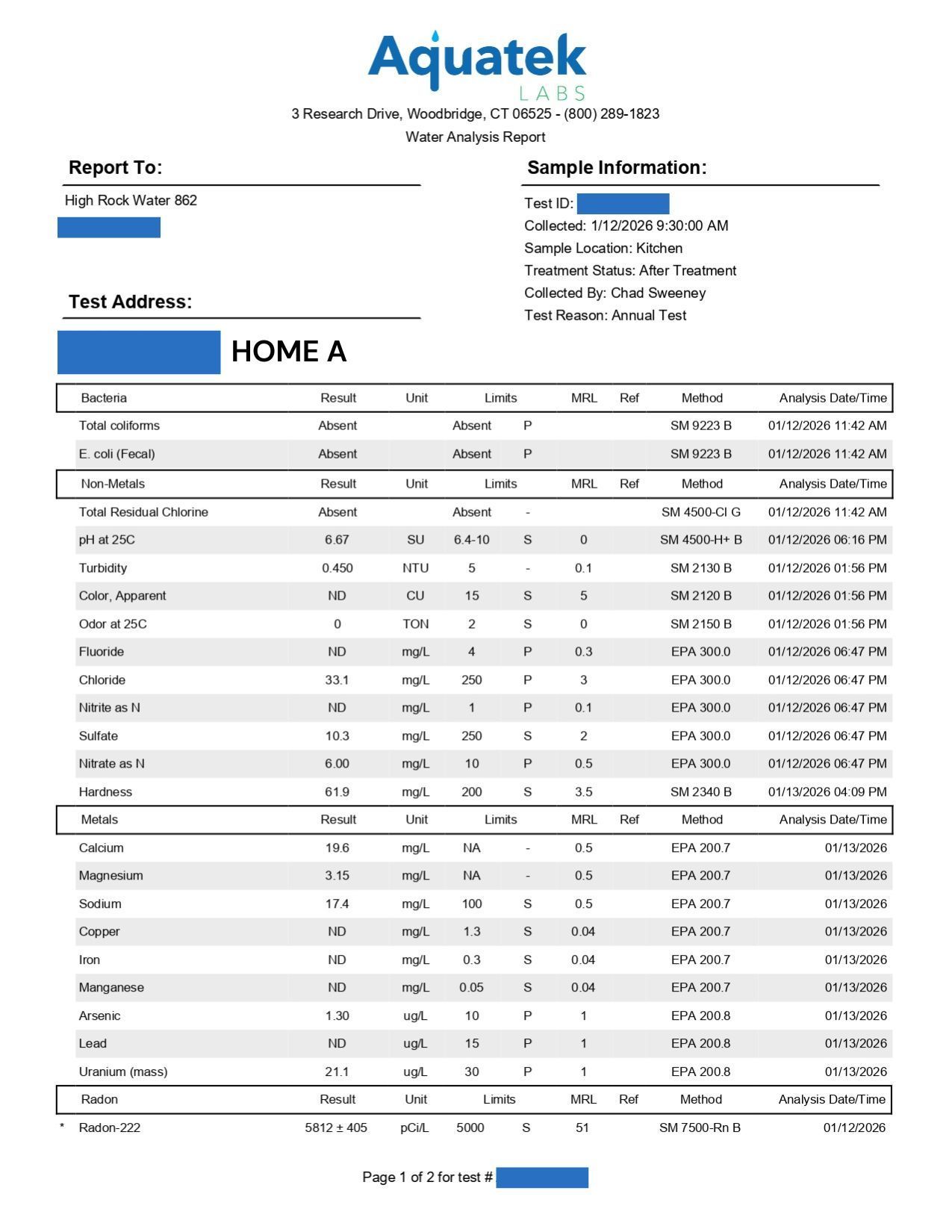
- Home A registered Radon-222 at 5,812 ± 405 pCi/L. That exceeds Connecticut's advisory limit of 5,000 pCi/L, and it's a result that warrants professional correction, typically through a point-of-entry aeration system.
- Meanwhile, Home C at registered just 694 ± 48 pCi/L, comfortably within safe levels.
That's a difference of more than eight times between two Oxford homes. Same town, same general area, vastly different radon exposure.
This is one of the most important lessons well owners consistently resist accepting: radon depends almost entirely on hyper-local geology. The bedrock beneath your specific well determines your radon risk, not the road you live on, not your neighborhood, and certainly not what your neighbor's test said.
According to the EPA, radon exposure becomes particularly dangerous when it enters indoor air during showering, laundry, and daily water use. Long-term exposure increases lung cancer risk. Even when a lab summary doesn't flag radon as a pass/fail issue, levels above the advisory limit should never be left uncorrected.
Chemicals and Metals: Mostly Good News
For the Oxford homes where full chemical and metal panels were run, the results were largely reassuring.
Arsenic was detected at 1.30 µg/L at Home A, well below the 10 µg/L regulatory limit. Uranium came in at 21.1 µg/L, also below the 30 µg/L limit. Lead and Copper were not detected. Water hardness ranged from not detected to moderate levels, and sodium was within normal ranges.
This pattern suggests that Oxford's primary water challenges are biological (bacteria) and geological (radon), not industrial or chemical contamination. That's actually meaningful, good news for the town overall, but it doesn't diminish the urgency of addressing the issues that do exist.
The Most Important Lesson: Test First, Assume Nothing
Looking across all five of these Oxford results, one conclusion rises above every other:
You cannot assume anything about your water based on where you live.
- Two homes on the same road, both had coliform contamination, yet one had E. coli, and one didn't.
- A home with elevated radon sat in the same town as a home with radon nearly ten times lower.
Properties that looked clean on the outside returned failed tests. Properties with treatment systems in place still need evaluation.
There is no pattern visible from the street, no smell, no color, no taste that would have predicted any of these results.
This is exactly why professional water testing isn't a precaution; it's the only way to know what's actually in your well. Annual testing is standard practice for any private well. But as Oxford's results show, radon, metals, hardness, and pH all deserve attention too.
Our Commitment to Oxford
At High Rock Water, we've worked across Oxford and the surrounding towns and seen firsthand how dramatically water conditions change from one property to the next, sometimes on the same street.
Our role goes beyond running a test. We help homeowners understand what their results actually mean, identify risks that a lab summary might not flag clearly, and recommend solutions designed for their exact conditions, not a generic one-size-fits-all approach.
Because protecting your water starts with understanding it at a local, property-by-property level.
Common Questions About Well Water in Oxford
My water looks and tastes fine. Do I still need to test?
Yes. Common contaminants in Oxford, CT, such as bacteria, radon, arsenic, and uranium, are all undetectable by sight, smell, or taste. The only way to know is to test.
My neighbor's water tested clean. Does that mean mine is too?
No. As Oxford's results clearly show, two homes on the same road can have completely different water quality. Your neighbor's test tells you nothing about your well.
What happens if my water tests positive for coliforms?
Well, shock treatment followed by re-testing is the standard first response. However, understanding why contamination is occurring, such as cracked casing, surface intrusion, and septic proximity, is just as important as the initial treatment.
What should I do about radon above the advisory limit?
A point-of-entry aeration system is the standard professional solution. It addresses radon in water before it enters your home's air supply.
How often should I test?
At a minimum, annually for bacteria. Every few years, for a full panel including metals, radon, pH, hardness, and sodium, or any time you notice a change in taste, color, or odor.
From Uncertainty to Real Control
Water quality issues rarely announce themselves. There's no alarm when radon rises. No warning when bacteria enter a well. No obvious sign when the pH turns quietly corrosive.
That's precisely why the homes in Oxford that tested positive for bacteria were a surprise; they looked no different from the clean homes.
The only moment of real certainty comes from the test itself. And in a town where results vary as widely as Oxford's do, that certainty is worth every bit of the effort it takes to get it.
Schedule your professional well water test today and get a clear answer about what's actually in your water.
Sources: Field testing data from Oxford, CT residential well reports. United States Environmental Protection Agency guidelines for radon, bacteria, and drinking water contaminants.
CT'S Best Well Water Service Professionals
OVER 50 YEARS OF COMBINED EXPERIENCE
Our plumbers have a profound experience on working residential property.
CERTIFIED & LICENSED PLUMBERS
Our plumbers have the latest certifications and trainings to ensure they are educated on new technology.
FREE QUOTES ON ALL SERVICES
At High Rock Water & Mechanical Service, we provide free quotes for any of our customers.
WELL KNOWN IN THE CONNECTICUT AREA
We have been servicing our customers in and around the western and central CT area for over a decade.
HIGHLY RATED ON GOOGLE
Our reviews show how dedicated we are to helping our customers.
100% CLIENT SATISFACTION
Our goal is to have all of our customers to be happy customers and to think of High Rock Water & Mechanical Service whenever they need us.